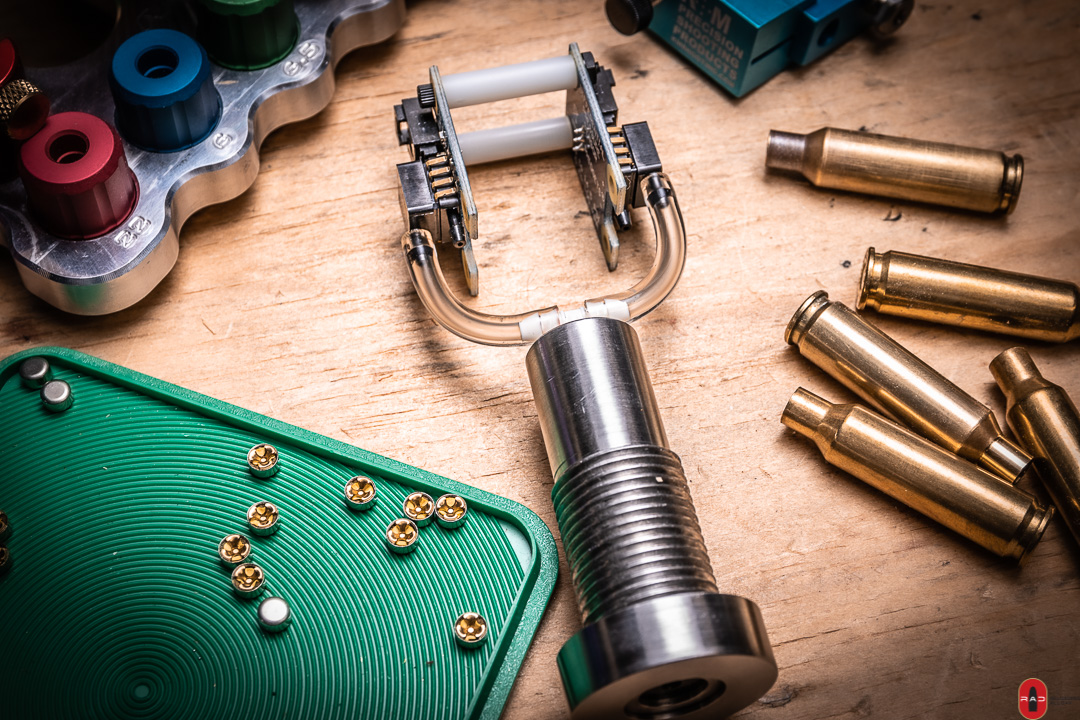
Measuring Cartridge Case Volume

In this post I address the use cases for measuring case volume. Reloaders have gotten by for quite a while without measuring the volume of every case. Most reloaders never measure case volume. What are the reasons anyone would want to?

If you are interested in the Bison Armory Case Volumizer you can see them in our online store here.

In the past, measuring case volume was a slow task. Typically the reloader would weigh a case, fill it with water, then re-weigh the case to measure the weight of the water that filled the case. Obviously not the most desirable method. With the new Bison Armory case volumizer, the task is simplified to the point that it takes only minutes to accurately measure the volume of 100 or more cases.

Prior to this, there was not much point in discussing the reasons for measuring case volume. The cost in terms of time and effort were simply not worth the resulting information. Now that cases are easily measured with the Bison Case Volumizer (BCV), the question of why becomes interesting.

Checking for bad cases

Split case necks and other defects are real. Are you hunting? Shooting in a match? Going to a training class? The BCV easily detects any case with split neck or other compromise to its structure. A volumized case is one you can rely on.

Pushing the limits

Bison Armory does not advise pushing muzzle velocity to the limits, but we know some reloaders will do this. Suppose you are reloading all Winchester cases and a Starline case sneaks in. If you are pushing velocity to its maximum safe limits, a case with lower capacity than expected, like you might get from one from another brand sneaking into your batch unknown, could cause catastrophe. The BCV will detect these cases. In addition, suppose a new lot from the same manufacturer happens to be low. Manufacturing tolerances will vary somewhat even for the best manufacturers. The BCV when used properly and within its limitations, will alert the reloader to these sort of situations.

Long range accuracy

At 500 yards and beyond, variation in muzzle velocity starts to have a significant effect on accuracy. I shoot long range matches in F-Class and Service Rifle categories. Pushing the 223 Rem to 1000 yards is a lot of fun with the right bullets, but how much does variation in case volume affect long range accuracy? Quickload is a handy tool for cursory investigations into this question.

We can start with the common question of how much does variation in powder charge affect velocity and hence vertical dispersion at long range. For the 223 Rem with my personal load of 22.2 grains of H4895 in a Winchester case behind a 90 grain Sierra MatchKing bullet, we find a nominal muzzle velocity of 2550 fps. Quickload says +/- 0.1 grains of H4895 will result in +/- 10 fps out the muzzle. For my pet 223 long range load, that means the following vertical dispersion at distance:

Distance (yards)Velocity Low/High (fps)Drop Low/High (in)Drop Low/High (moa)
6001718 / 173486.9 / 85.213.8 / 13.6
7001601 / 1617 134.6 / 13218.4 / 18
8001492 / 1506 195.8 / 192.123.4 / 22.9
9001390 / 1404272.8 / 267.628.9 / 28.4
10001298 / 1310367.7 / 360.735.1 / 34.4

Now we know why long range shooters spend $1000 on an Autotrickler powder measure in order to throw charges quickly to +/- 0.02 grains. 1.7 inches at 600 yards and 7.0 inches at 1000 yards will lose you some X’s and 10’s.

What about case volume variation? Quickload tells us that variation of +/- 0.25 grains of powder will result in a muzzle velocity spread of 20 to 30 fps in the 223 Rem and variation of +/- 0.5 grains in the 260 Rem will see about 20 to 30 fps variation as well, depending on bullet, powder, and powder charge etc. As a fraction of case volume the variation is about the same.

Note: The velocity change for 223 Rem from +/- 0.25 grains of case volume is about the same as for +/- 0.1 grains of charge weight. So if you care about charge weight variation you probably ought to at least be interested in case volume variation.

I have verified this through experiment. Admittedly not a huge numbers on the surface, but how will this affect my performance in a match? With a low muzzle velocity of 2546 and a high of 2563 (difference of only 18 fps) we get the following trajectory table using Hornady’s ballistics calculator:

Distance (yards)Velocity Low (fps)Velocity High (fps)Drop Low (in)Drop High (in)Diff (in)Drop Low (moa)Drop High (moa)Diff
(moa)
5001847186150.649.90.79.79.50.2
6001723173686.3851.313.713.50.2
70016061619133.7131.72.018.2180.2
80014971508194.6191.63.023.222.90.3
90013951406271266.94.128.728.30.4
100013021312365.3359.75.634.934.40.5

The X-ring of the MR target is 3 inches and the 10 ring radius is 6 inches. At 500 yards the 0.7 in difference between high and low is pretty small but could cost an X or a 10 on shots that the shooter puts at the outside of the ring. At 600 yards the variation almost doubles and can start costing X’s and points.

For 800 to 1000 yards we shoot at the NRA LR target with an X-Ring that is 5 inches in radius and a 10-Ring that is double with a 10 inch radius. It is clear that the difference of 3, 4.1, and 5.6 inches between the low and high velocity values at 800, 900, and 1000 yards respectively can cost a lot of X’s and points. At 1000 yards in particular, the vertical dispersion is slightly larger than the width between rings.

Volume variation in Winchester 223 brass

I measured the volume of 98 Winchester 223 Rem brass cases and got the following results
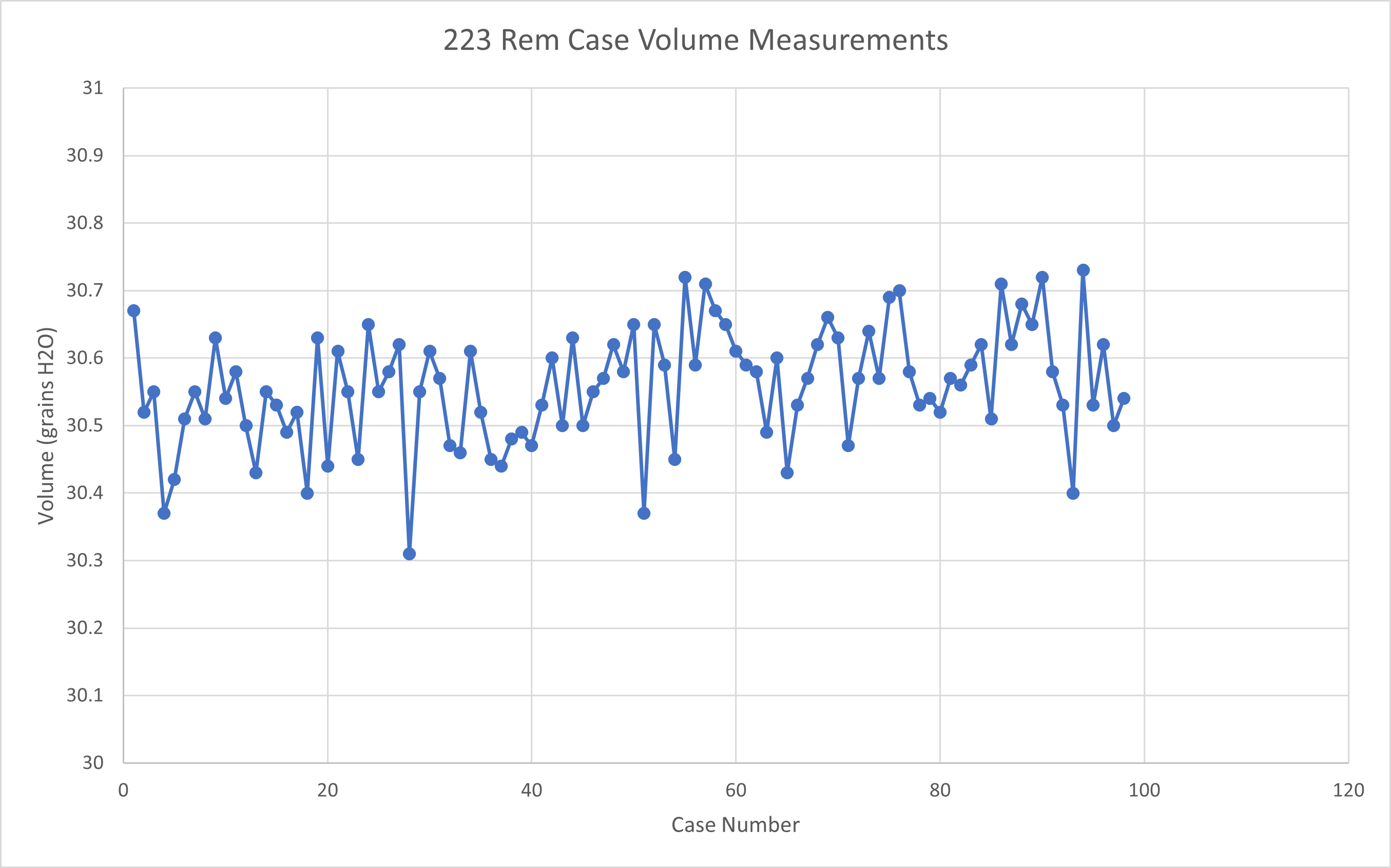
The low value was 30.31 grains H2O and the high value was 30.73 for an extreme spread of 0.41 grains with a mean of 30.56, a median of 30.57, and a standard deviation of 0.09 gr H2O. Pretty good results actually. I’ve seen outliers with much bigger deviations. This is good brass. An outlier will definitely cost points during a match.

Once measured, what do you do with the cases? My personal approach is to omit any outliers and then split the rest at the mean or median to use for a 20 round match plus sighting shots. In this situation they are effectively the same. In this way I assure that my ammunition for a 20 round match will exhibit minimal vertical dispersion at long range, having in this instance a variation in case volume of +/- 0.1 grains H2O

In the next article I will compare measuring case volume by water weight using an FX-120i scale with the results from the Bison Armory Case Volumizer.
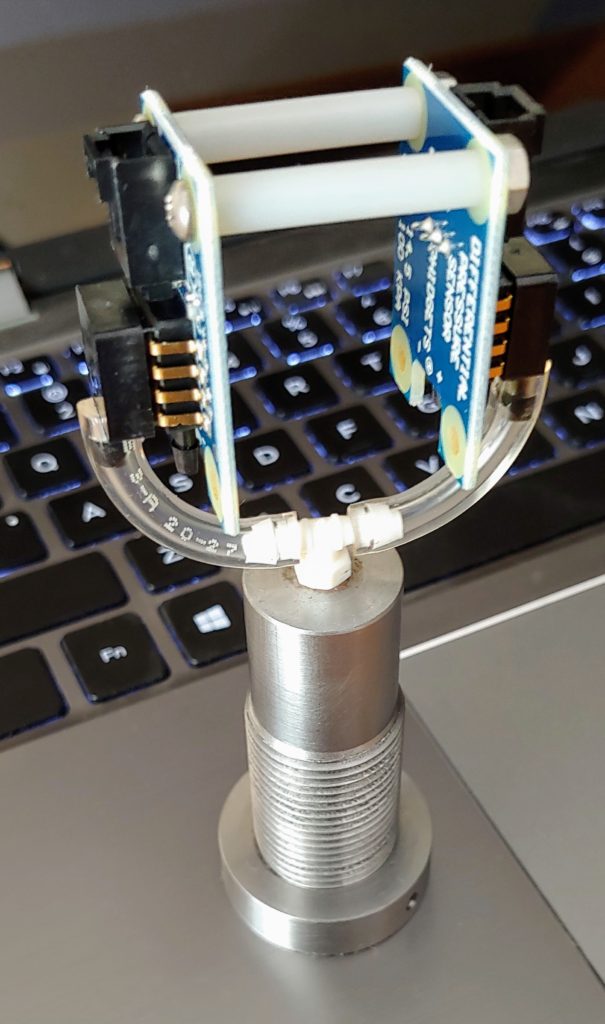
Dr. Triplett’s Cartridge Case Volumizer

The Alpha version of Dr. Triplett’s Cartridge Case Volumizer (DTCCV) is coming soon! Measure case capacity in grains of H2O in around 2 seconds per case using your reloading press and Windows 10 computer.

The Alpha version is intended for scientifically minded early adopters who are reasonably tech savvy.

More details coming soon!

UPDATE!

Get your Case Volumizer at Bison Armory now!

Bison Armory Case Volumizer – Bison Armory Store

View the instruction videos on YouTube:

Reduced NRA High Power Target Dimension Calculator

I’ve created a calculator that computes reduced NRA High Power target dimensions so that you can create your own SR, SR-3, MR-1 and other targets to match your distance and caliber:

To draw the targets you will need a vector graphics program like Corel Draw. They have a home and student version available here:

https://www.coreldraw.com/en/product/home-student/

Here’s an example of a target I created for shooting offhand at the SR 200 yard target at our local 25 yard indoor range:

The target is made to be printed on tabloid sized 11×17 paper. The HP 7740 wide format printer for around $180 can’t be beat and has printed many of these targets for me.

224 Valkyrie 88 ELD

I finally dialed in the 88 ELD with my latest hand loads. Until now the factory Hornady 88 ELD has out-shot what I was doing in the reloading room. I noticed that the factory loads are very light, to the point that the action cycles very mildly. I backed my loads down a bit and loaded them closer to the factory 2.260″ OAL, with my loads coming in now at 2.270″.

The secret sauce is 26.5 grains of Winchester 760 powder, Starline brass, and Winchester small rifle primers. I didn’t measure muzzle velocity but the loads still seamed hotter than factory, so I’m guessing 2650 fps from the 22″ barrel (factory shot 2650 fps from my 24″ barrel.)

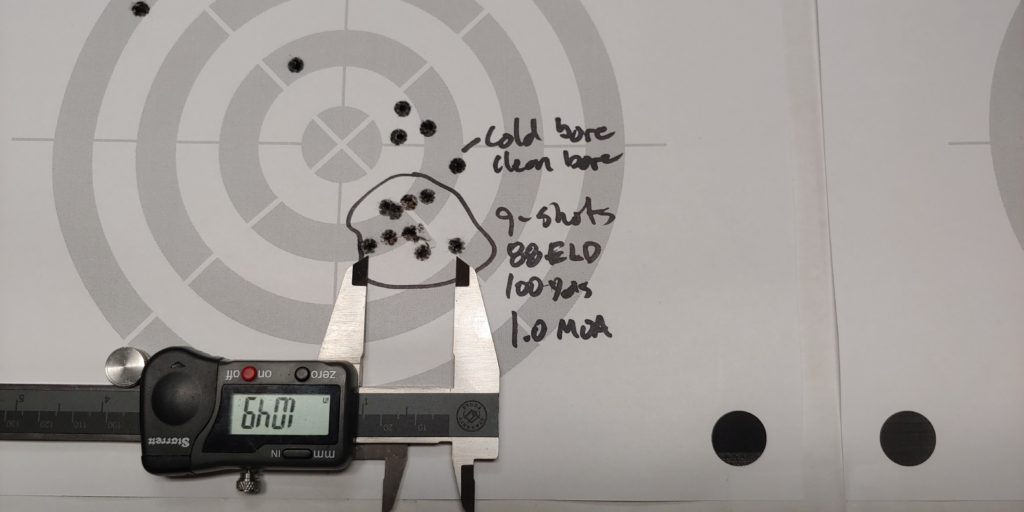
I was able to shoot two 1 MOA groups, one with 9 shots and the other with 7, at 100 yards. I need to fine-tune this load now and then stretch its legs, but I expect good things given how the factory loads shot at 1000 yards last year from the 24″ barrel.

The group below is pretty satisfying at this point. Notice how you could combine those shots in different ways to get several sub-moa 5-shot groups. Never trust low round counts. I plan to refine this load a bit more, probably just drop to 26.4 grains and see how it shoots. I’ll put up a 20+ round group to see what we get.

22" 224 Valkyrie 88 ELD

Oregon Service Rifle State Championship 2019

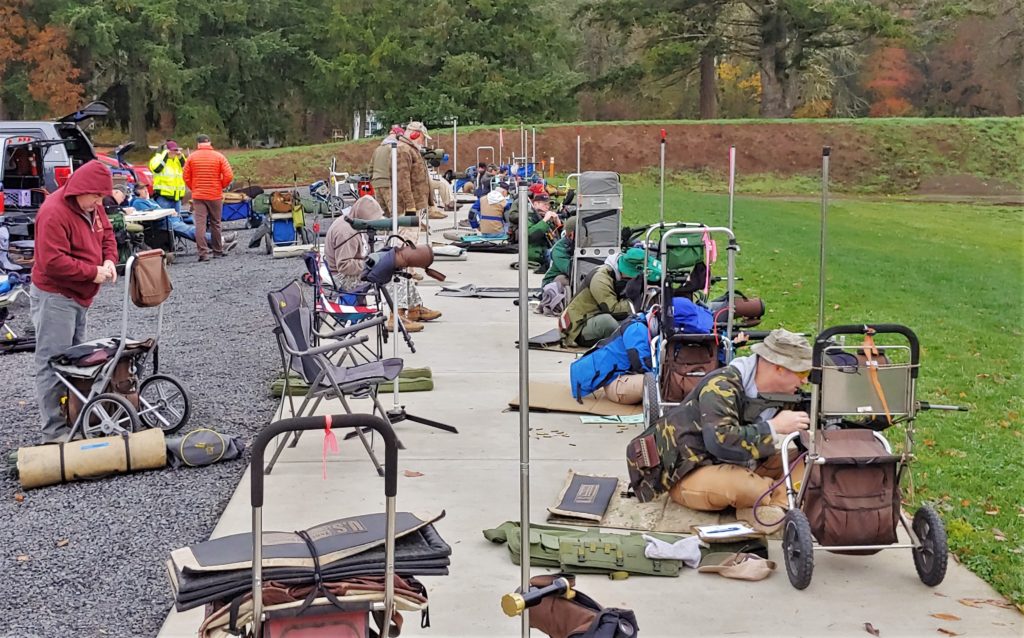
Great fun was had by all. I wasn’t particularly good but doing better than my average. I earned the top novice award but then couldn’t accept it because I’m not an Oregon resident. I did get a CMP bronze pin though, my first acheivement in highpower. Highpower rifle is great fun and I recommend anyone interested to check out the various disciplines available at Douglas Ridge Rifle Club in Eagle Creek Oregon. I shoot F-Class and Service Rifle there and it’s a blast.

Oregon State Service Rifle Championship 2019, relay 3 getting ready to shoot sitting rapid fire at 200 yards.

For beginners, check out their Service Rifle Program, which is a sequence of friendly matches throughout the year geared towards novice competitive shooters. They have M1 Garand rifles and ammunition available and the cost is very inexpensive for a day of fun.

Rifle Ammunition Load Workup

We have all read forum posts in which the author describes their load workup process and the resulting shot groups. Many of us have written such forum posts, myself included. Typically these posts start with a detailed description of the rifle and ammunition components and then outline the loading process and strategy. Factors such as cartridge OAL, powder type and charge weight, and bullet will be varied to some degree, and the author will shoot several five-shot groups in which each is a little different from the others.

Here’s a good example of such a post on the 224 Valkyrie Forum.

When the shooting is done, we get to see the targets and corresponding shot groups from all the lead that was sent down range. The five-shot groups are compared, and conclusions are arrived at that feel good and seem reasonable. Usually one or two groups stand out and the author declares that the weapon really liked that particular variation of ammunition, and the less desirable groups are thought to contain fliers from poor shooting technique or a larger group dispersion from an ammo variation that the weapon didn’t like.

I am just as guilty as the next shooter of going about load development in the manner described above. I’ve been looking into the random nature of ballistics a lot lately, mostly driven by the content at Ballistipedia, and the more I read up on the subject, and the more I apply the statistical analysis to my shooting data, the more I see that this typical ammunition loading development process is extremely bad.

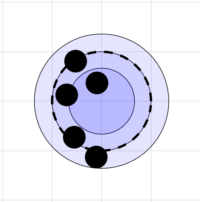
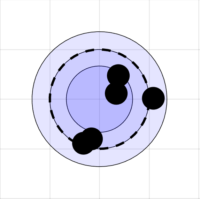
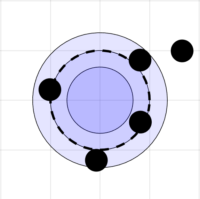
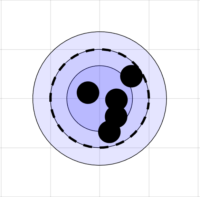
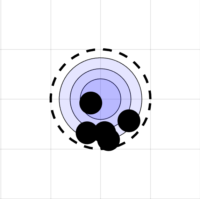
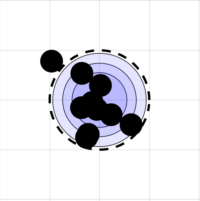
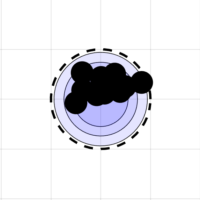
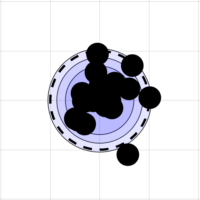
Thanks to computers and math, I can demonstrate why this common load development process is so terrible. Consider the following simulated load development results. The center of the black and purple circles is the true point of aim and the black dashed circle represents 1-moa diameter:

Simulated group 1 – dashed black line is a 1-moa diameter circle
Simulated group 2
Simulated group 3
Simulated group 4

In the manner of our typical rifle load developer (self included) I would conclude with the following: Group 1 is a good start. Group 2 is headed in the right direction and if my breathing had been better I’m pretty sure it would be a tighter group. Group 3 not only did the rifle did not like this load, but I flinched and got that flier you see. Finally, for Group 4 the rifle really liked this load. So what’s the problem? Don’t those conclusions seem to follow from the data.

The problem is that there’s absolutely ZERO difference between the four groups shown above. Sure, the bullet holes are in different places in the four groups, but the exact same statistical distribution generated all four groups. In this case they are generated from a distribution that has a mean radius of 0.4 inches. The purple discs indicate the expected extreme spread that would be generated by a weapon and ammunition with that shoots with a 0.4 inch mean radius. The inner disc represents the largest expected extreme spread of the smallest 10% of groups that this distribution would generate, while the outer disc represents the smallest expected size of the largest 90% of extreme spreads that would be generated. And that’s knowing ahead of time that the rifle will shoot with 0.4 inch mean radius.

This result demonstrates one thing clearly: Much time and effort is wasted in load development. The rifle shooter who is interested in precision load development must pause for a moment and ask this question: What is the purpose of my load development process? It could be for one of the following:

  • Hunting
  • Service rifle competition
  • F-class competition
  • CQB defense
  • Other?

If hunting is the purpose for the load, then the hunter would likely prefer a flat shooting load that is accurate enough for the job and delivers adequate energy at the point of impact for a clean kill. Hunting range may vary depending on the game, environment, and other circumstances.

For competition shooters, accuracy is the primary consideration, but muzzle velocity influences time of flight and hence the variation due to wind. Variation in muzzle velocity will also have a significant effect at longer ranges on both vertical dispersion in general and horizontal dispersion due to wind.

Let’s consider the case of a 600 yard prone match for F-class or service rifle. In this case, we would like adequate muzzle velocity and then the best accuracy possible from our ammunition. Suppose this rifle is capable of a mean radius of 0.25 inches. A 5-shot group from this rifle might look like the following:

Typical group 0.25″ 100-yard mean radius – dashed black line represents 1-moa diameter

Will this group suffice for our upcoming 600yard prone match? It’s pretty tight, but notice that it is off-center by enough that if we zero our rifle from this group, we will score poorly and not place very high in the match. If we shoot a 10-shot group we’ll get something like the following:

10-shot group with 0.25″ 100-yard mean radius

Ten shots does a little better. The purple discs that show expected extreme spreads are getting closer together, and our zero from this group would do for competition. Still, we could shoot several of these groups and might be tempted as we were with our 5-shot groups to come to invalid conclusions. Another 10-shot group could be:

Another 10-shot group with 0.25″ 100-yard mean radius

This group is tighter than the last one but the zero is misleading and a scope zeroed off this group will lose us points in our match. How does a 20-shot group look?

20-shot group with 0.25″ 100-yard mean radius

This looks like a group that we could potentially start to trust to zero our rifle and to be representative of the potential of the rifle and ammo that we are shooting. It has an expected mean radius of .24″ and the actual group mean radius measures 0.25″. They expected extreme spread 90% min and max circles are coming closer together as well and will converge as the number of shots in the group goes up. They don’t really converge until the round count is in the hundreds, which is impractical.

The point of this post is to show that 5-shot groups cannot distinguish in any meaningful way between groups that are shot with small variations in loading parameters. A 10 shot group might start to give some sort of confidence, but 20 or more are needed to at least establish a baseline. The real question is how to tell if a given group is statistically different from the baseline? How many shots are needed and how different to the groups need to be in order for a claim to be made that some change in loading parameters was a likely cause of the difference? I will try to address that in a follow-up post.

New Federal Gold Medal Match 224 Valkyrie Ammunition

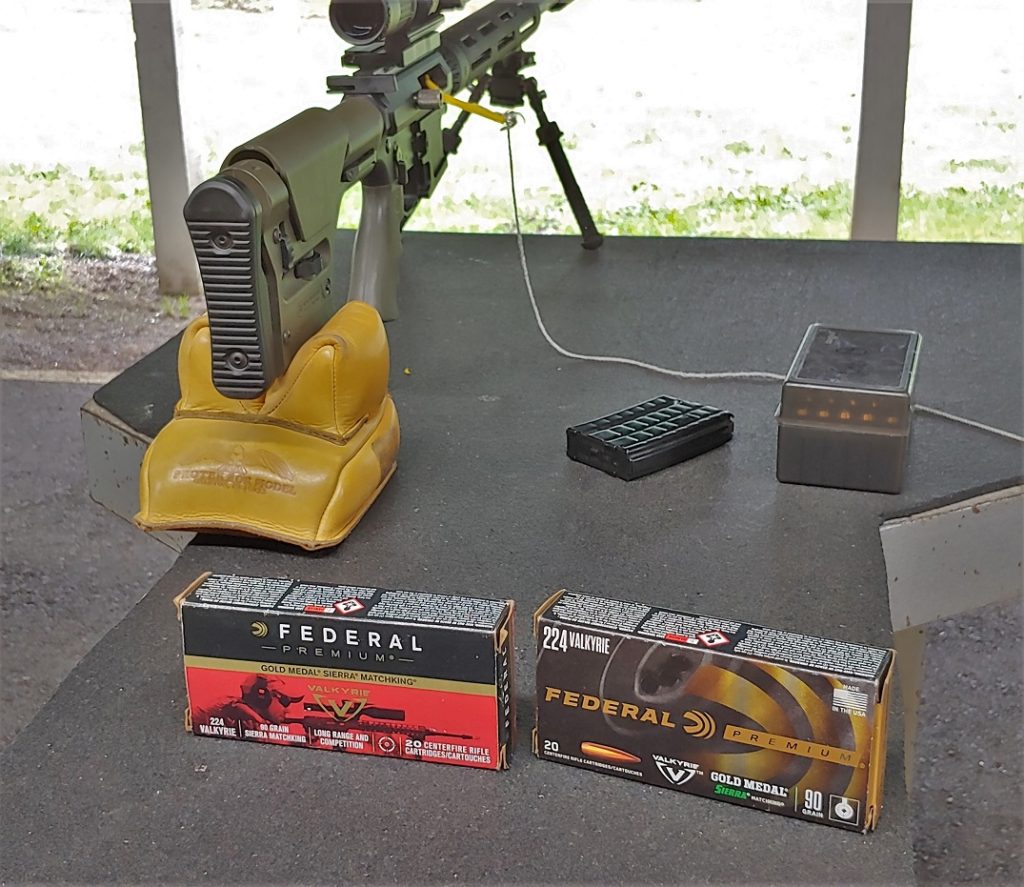
I got a couple of boxes of the updated Federal Gold Medal Match 90 SMK ammo to the range today. I have NEVER been able to shoot well with the original offering of this ammunition from Federal, typically shooting 2″ to 3″ groups or worse, with the barrel seemingly spraying bullets everywhere. I ran my Bison Armory 24″ barrel with a Yankee Hill Resonator 30 cal silencer. I’m shooting at the 100 yard range at Clark Rifles near Vancouver Washington.

Old package on the left, new package on the right. I got the new ammo, in updated packaging, topped with the 90 SMK with the new thicker jackets and crossed my fingers. The results were excellent:

First two groups out of my rifle were five shots each of the FGMM loads, labelled as such on the target. Both came up 0.78 MOA. The ammo was running about 2650 and was surprisingly consistent in terms of velocity. I shot some of the old stuff, from a later batch therein, which ran a little over 2700 fps. Federal has backed off on the load a little as their earlier loads were way too hot. The old batch I ran I think was from a second run as it wasn’t as hot as the original stuff, and didn’t spray all over the place, but still only managed about 1.26 MOA, which is quite a bit better than what I’m used to.

I also got in a box of the new 90 SMK bullets from Sierra with the thicker jackets and loaded them up. I used an RCBS neck-bushing die to resize the once-fired Starline brass. I’m going to stick with the neck bushing die for loading this ammo from now on. First group out is at the bottom right, 5 shots into 0.48 MOA. These loads were light at 2590 fps or so, which stays above 1200 fps past 1100 yards. The light loads used 26.5 grains of Win 760 loaded to 2.290″ OAL. The next two loads shot nicely sub-MOA at 27.0 and 27.5 grains for 2650 and 2700 fps respectively. At 2700 fps these bullets are staying above 1200 fps to 1200 yards. I think this load, and the factory load, can shoot at 1000 yards out of a 20″ barrel with some legs to spare.

The two un-annotated groups are from my 22″ upper. The really poor group is one of my hand loads, and that barrel always shoots my SMK hand loads poorly. The smaller group that isn’t marked is the 90 SMK FGMM stuff, which shoots a lot better from this barrel than my hand loads. Go figure. That barrel has not impressed me and only really likes the 85 RDF for some reason. Still, keeping below 1.25 MOA consistently is good for that barrel.

I’m extremely pleased to see that Federal and Sierra have figured things out.

Long Range 6.8

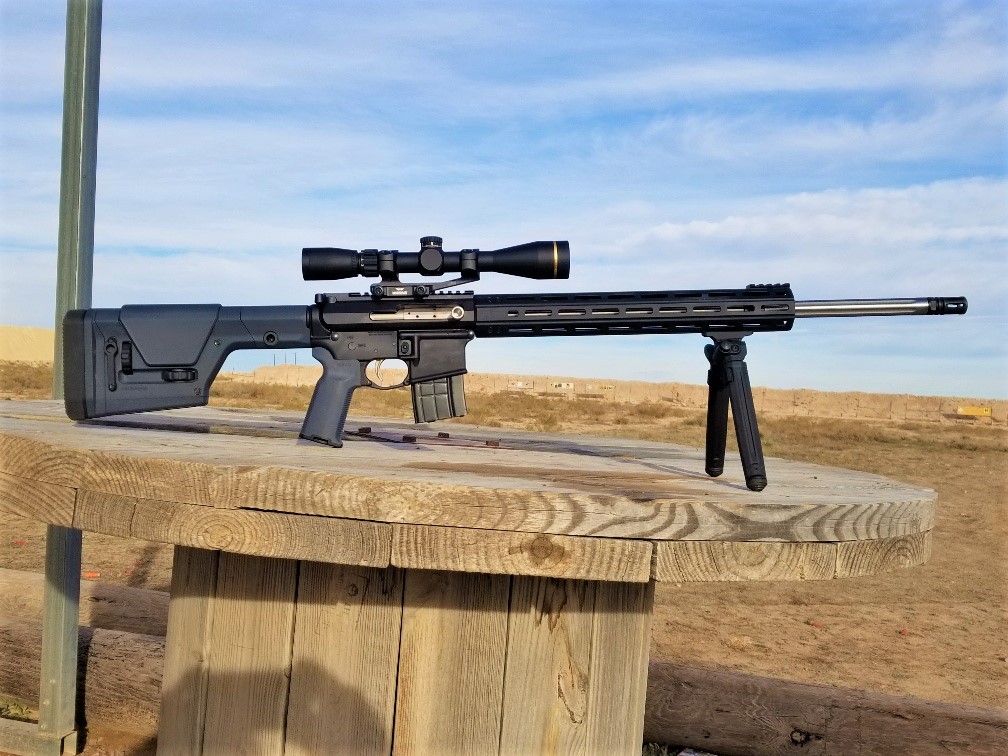
A customer sent me this photo of his fine Bison Armory based rifle. The 22″ 6.8 can reach out there. The customer got the last of our Mega billet side charge upper receivers. Mega is gone and there won’t be any more of these fine upper receivers. I built all my long-range AR-15 rifles with these SBU side charge receivers, they are bulky and burly and absolutely perfect for the job.